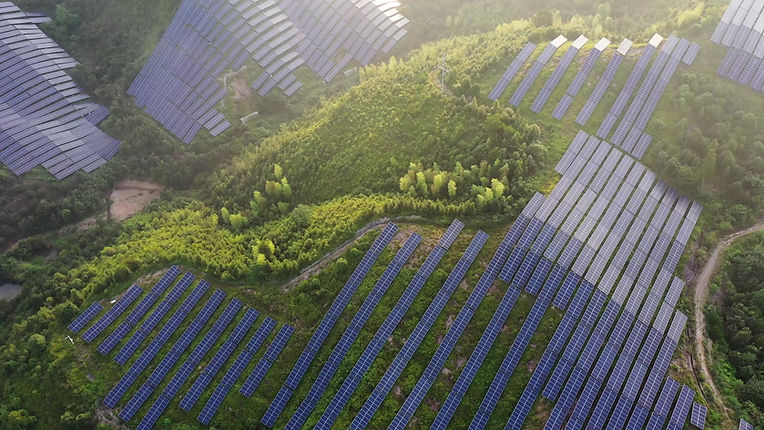
Renewable Energy: Solar Energy
How Do Solar Panels Turn Sunlight into Power? (For Grades 4-7)
At first glance, a solar panel might just look like a shiny rectangle sitting on a roof. But inside, there’s a brilliant process happening—one that turns sunlight into electricity without any wires, fuel, or noise.
It all starts with the sun.
When light hits a solar panel, it triggers a chain reaction at the atomic level—using special materials, smart design, and a bit of physics magic to create energy we can actually use.
Here’s how it works, step by step:
1. Sunlight Arrives
The sun sends out tiny packets of energy called photons. When these photons land on a solar panel, they set the process in motion.
2. The Solar Cells Wake Up
Solar panels are made mostly of silicon (Si)—a super common element found in sand. On its own, silicon isn’t very exciting. But when we add tiny amounts of other materials (called impurities), something amazing happens.
These impurities create two special silicon layers:
-
One with extra electrons (negative charge)
-
One with missing electrons, or "holes" (positive charge)
When these layers are stacked together, they form an electric field—like a one-way street for electrons.

Solar Power - How it Works Today. Credit: MIT CATE - Climate and Renewable Energy (6-8)
3. Photons Knock Electrons Loose
When sunlight hits the panel, the photons bump into the silicon atoms and knock electrons loose.
Thanks to that built-in electric field, the freed electrons get pushed in a single direction.
4. Electricity is Born
That movement of electrons through a circuit? That’s electricity!
5. The Power Gets to Work
The electricity produced by the solar panel flows through wires to power whatever it’s connected to—whether it’s a lightbulb, a motor, or an entire home.
Solar panels installed on rooftops—even small ones—can generate enough electricity to power everyday home appliances like refrigerators, lights, heaters, and TVs.
Best of all, making electricity from sunlight produces no carbon dioxide, which means it doesn’t add to global warming. Once the solar panels are manufactured, installed, and paid for, the electricity they generate is completely free.
Clean. Renewable. Limitless. That’s the power of solar energy at work.
Video: How do Solar Panels Work (For Grades 6-10)
Let’s Go Deeper with the Physics (For Grades 8-10)
How Silicon Makes It All Work
Silicon (Si), the main ingredient in most solar panels, has four valence electrons. That means it can conduct electricity—but not very well. This is why silicon is known as a semiconductor: it falls between a conductor (like copper) and an insulator (like rubber).
To make silicon more efficient at conducting electricity, scientists add small amounts of other elements in a process called doping.
-
Phosphorus has five valence electrons. When added to silicon, it donates extra electrons, creating n-type (negative-type) silicon.
-
Boron has only three valence electrons. When boron is added, it creates “holes”—spaces where electrons should be. These holes behave like positive charges, creating p-type (positive-type) silicon.

The image above shows n-type doped silicon with phosphorous used as dopant and p-type doped silicon with boron used as dopant.
When you stack a layer of n-type silicon on top of a layer of p-type silicon, something powerful happens:
You create a p-n junction—a built-in electric field that acts like a one-way gate for electrons.
When sunlight hits the solar panel, photons excite the electrons in the silicon. The electric field in the p-n junction pushes the freed electrons in one direction, creating a flow of electric charge.
That flow? It's what we call electricity—and it's the heart of how solar panels turn sunlight into power.

Solar for All: The Next Challenge
Solar energy is growing fast—over 5.4 million U.S. systems* are already installed, and by 2030, that number could more than double**.
This is the next challenge:
How do we design solar that works for all neighborhoods, not just some?
How do we make it cheaper, easier to install, and built for real-world lives? The future of solar isn’t just about scaling up.
It’s about building fair, flexible systems that reach everyone.

Redesign the Future: Why This Matters—and Why You Matter
That flow of electrons? That’s electricity—and it’s how solar panels turn sunlight into power.
But here’s the bigger idea:
If we can make this process more affordable and scalable, we can bring clean energy to more homes, schools, and communities worldwide. That means less pollution, more access, and a real shot at solving one of the biggest challenges of our time.
Solar panels aren’t just about science—they’re about design.
They prove that we can take something ordinary, like sunlight, and turn it into energy, opportunity, and progress.
But even the smartest solutions don’t change the world unless they’re built to reach everyone.
That’s where you come in.

Think like a climate designer.
Start with empathy. Zoom out. Look at the full system. And ask bold, imaginative questions like:
-
What if we could store solar energy in every building material—like paint, glass, or bricks?
What if city streets could store energy during the day and light themselves at night? -
What if AI helped communities design smarter, fairer energy systems in real time?
Because when we make solar energy accessible to all, we don’t just cut emissions—we create climate justice, energy equity, and a future where clean power is a basic right, not a luxury.
These aren’t just science fiction.
They’re design challenges waiting for your imagination.
You don’t need to be scientist or engineer start.
You just need to care, stay curious, and keep asking:
What if we got this right?

* Solar Energy Industries Association (SEIA). SEIA & Wood Mackenzie. U.S. Solar Market Insight 2024 Year-in-Review.
** National Renewable Energy Laboratory (NREL). Residential Solar Adoption Trends and Forecasts.